

Selling in mid- to large-sized businesses is never as straightforward as selling to small businesses.
Closing a sale with large organizations often means convincing a group of stakeholders–the decision-making unit or “Jury” in the terminology of The MIT Entrepreneurship Center–to fire their existing solution, and reassign their budget to your solution.
Driving a sale through means understanding the needs and concerns of the buying influencers, from the User Buyer to the Technical Buyer, all the way to the Economic Buyer, the person most concerned with the return on investment (ROI) of your product or solution.
In this article, we take a look at the role and influence of the economic buyer on the buying process.
Economic Buyer Definition: What is An Economic Buyer?
The economic buyer–sometimes also called the budget owner–acts as gatekeeper of the budget.
He, or she, may be the CFO, the CEO, or any other manager controlling a sizeable budget.
They reinforce company needs and priorities through their veto over purchase decisions.
Budget owners generally care about the risks and the long-term impacts of the deal. They may ask questions about what happens if your company goes out of business, a key executive leaves, or you get acquired. The greater the dollar value of the deal, the higher up in the company budget owners generally are.
With the growing influence of procurement departments in large organizations, the role of the economic buyer is also changing. Through their responsibilities trying to maximize the value of company investments, procurement teams are sometimes able to sway the decisions of economic buyers.
Economic Buyer vs Decision Maker: Are They One and the Same?
Although economic buyers often have a lot of influence over purchase decisions, they’re not always the main decision-makers.
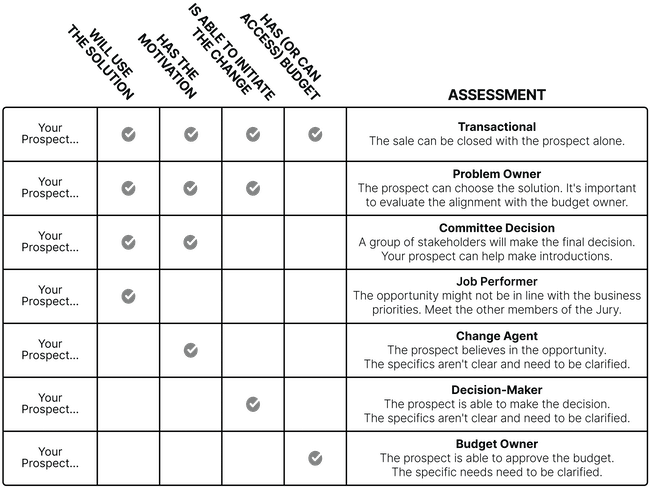
It can be useful to distinguish between the people who are able to initiate changes (decision-makers), and economic buyers. In many situations, they may be one and the same, but company governance structures don’t always line up.
Don’t make quick assumptions. The CEO isn’t always the economic buyer, and the technical influencers aren’t always in IT.
You can use a sheet like the following to assess accounts, one at a time:
How to Sell to Economic Buyers
As generalists, economic buyers almost always know less than you do about many areas of their industry; they don’t have the time to keep up with all the developments in their business. The most valuable contribution you can bring to an economic buyer is knowledge.
“Bring your economic buying influence information that serves as Windex for their clouded crystal balls.” – Robert Miller and Stephen Heiman, Strategic Selling Authors
Help them understand how other organizations are making their purchase decisions. Make the case for the return on investment of your solution. Tie it to the high-level objectives of their company. Assist them in research and decision-making.
You can map the buyers (technical buyer, budget owner, etc), organization by organization, using a table like the following:
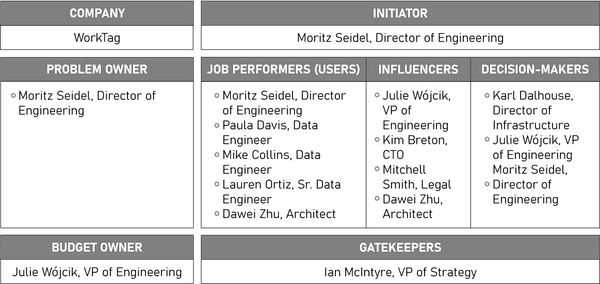
Start Mapping Your Buying Influencers – Get the Printable Buyer Map for Free
More on Economic Buyers
- How to Map Buying Influencers in B2B Customer Development
- Defining the Role of the User Buyer in B2B (Where They Are, and How to Sell to Them)
- How to Map the Needs of the Decision-Making Unit (DMU) in B2B Sales
Download the First 4 Chapters Free
Learn the major differences between B2B and B2C customer development, how to evaluate business ideas, and how to assess a venture’s risk in this 70-page sampler.
Working on a B2B Startup?
Learn B2B customer development with our free email course:

Pingback: The Role of the Technical Buyer in B2B Customer Development | Lean B2B: Build Products Businesses Want
Pingback: The Role of the User Buyer in B2B Customer Development | Lean B2B: Build Products Businesses Want
Pingback: How to Score Customer Problems by Budget Availability | Lean B2B: Build Products Businesses Want
Pingback: How to Know When You’re Ready to Close a Prospect in B2B | Lean B2B: Build Products Businesses Want
Pingback: How Much Money Can You Charge for Your Product
Pingback: How to Map Buying Influencers in B2B - Lean B2B: Build Products Businesses Want
Pingback: Early Pricing Assumptions Are About Learning, Not Profitability
Pingback: How to Know Who to Contact in B2B Customer Development
Pingback: How to Create An Ideal Customer Profile: Examples & Templates for 2019
Pingback: How to Map the B2B Buying Process With Customer Interviews
Pingback: MEDDIC Sales Process | Process Street
Pingback: MEDDIC: How to Get Higher Close Rates and Masterfully Qualify Leads (Free Template!) | Process Street | Checklist, Workflow and SOP Software
Pingback: MEDDIC: How To Get Higher Close Rates And Masterfully Qualify Leads (Free Template!) | Process Street | World Best News
Pingback: MEDDIC: How to Get Higher Close Rates and Masterfully Qualify Leads (Free Template!) - What's Trending !
Pingback: MEDDIC: How to Get Higher Close Rates and Masterfully Qualify Leads (Free Template!) - Marketing Magazine