

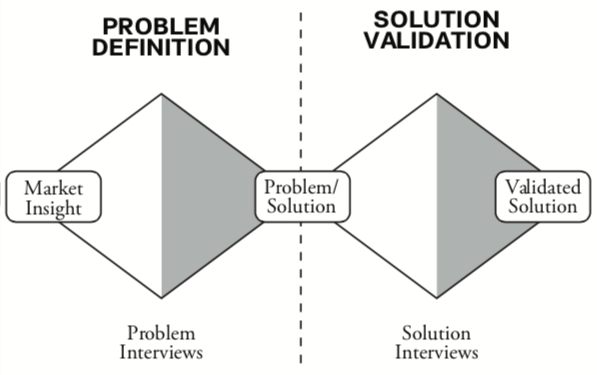
The customer development process in Lean B2B alternates between divergent and convergent phases allowing founders to explore, refine, and validate the elements of their business plans.
The UK Design Council created the Double Diamond design process in 2005 to capture this innovation process. It has since been widely-adopted in user experience circles, and it’s the foundation of the interview and customer development process of The Lean B2B Methodology.
Understanding The Lean B2B Methodology
The first half of the Double Diamond process helps entrepreneurs define the problem (customer discovery) while the second half is used to validate the solution (customer validation).
Although going through the four phases of the Double Diamond process might not require four separate series of customer interviews, all of these phases will need to be part of the customer development process of your startup if you are to be successful:
The 4 Phases of the Customer Development Process
- Discovery – Problem interview (divergent)
The starting point of the problem interview phase can be as little as a market insight around which you try to explore and discover problems and opportunities. Whether you have a good hunch for a problem or not, it’s best to start with a divergent interview to explore as widely as possible and learn about your prospects, their company, and their problems. - Drilldown – Problem interview (convergent)
The second problem interview helps the entrepreneur home in on problems and dig deep to understand the root causes and the impact that solving this problem would have. - Exploration – Solution interview (divergent)
The solution interview phase begins after you create a solution to your prospect’s problem. This stage is about exploring, iterating and testing the minimum viable product to maximize its impact and relevance with prospects. - Confirmation – Solution interview (convergent)
The final phase of the solution interview is about confirming that the solution provides enough value for money to change hands. The outcome of the confirmation stage is a solution that has been validated or invalidated by prospects, and a business model.
Plan to go through these phases in two, three, four, or more interviews. Although more than two interviews might feel like overkill for you, it’s best to plan for more than less and take your time.
Don’t rush customer discovery. Don’t settle for solving a low-impact problem or opportunity inside companies.
More on B2B Customer Development
- How to Make the Most of Your B2B Customer Discovery Problem Interviews
- How to Setup a Customer Development Panel in B2B
- 17 Fundamental SaaS Frameworks B2B Entrepreneurs Should Use
Download the First 4 Chapters Free
Learn the major differences between B2B and B2C customer development, how to evaluate business ideas, and how to assess a venture’s risk in this 70-page sampler.
Working on a B2B Startup?
Learn B2B customer development with our free email course:

Pingback: B2B Customer Discovery Interview Questions – The Master List | Lean B2B: Build Products Businesses Want
Pingback: Why So Many Startups Die Before Reaching Product-Market Fit - Lean B2B: Build Products Businesses Want
Pingback: The Top 10 Lean Startup in B2B Posts of 2015
Pingback: The Dangers of Building Features for Early Adopters in B2B
Pingback: Meeting Structure for B2B Customer Development Solution Interviews
Pingback: How to Make the Most of Problem Interviews in B2B Customer Development
Pingback: What The Best B2B Entrepreneurs Have in Common
Pingback: When to Stop Doing Problem Interviews in B2B Customer Development
Pingback: Questions d'entrevue B2B sur la découverte du client - La liste complète
Pingback: B2B Kunden Interviewfragen zur Entdeckung - Die Master Liste
Pingback: A Year in Review – Embracing the Broken Path - Étienne Garbugli
Pingback: Customer Segments: How to Evaluate Target Markets for your B2B Startup
Pingback: HOW TO PLAY YOUR FEATURES RIGHT OR WISE WAYS TO YOUR PRODUCT IMPROVEMENT — omega-r-blog
Pingback: Do You Have the Profile of a B2C or a B2B Entrepreneur? Find Out:
Pingback: How to Recontact Prospects to Get Your First 10 Customers – Full Guide
Pingback: Risk Identification: How to Assess Your Startup's Risks Before Launch
Pingback: Why So Many Startups Die Before Finding Product-Market Fit